The Bassin des Ladres: legend or cradle of thermalism?
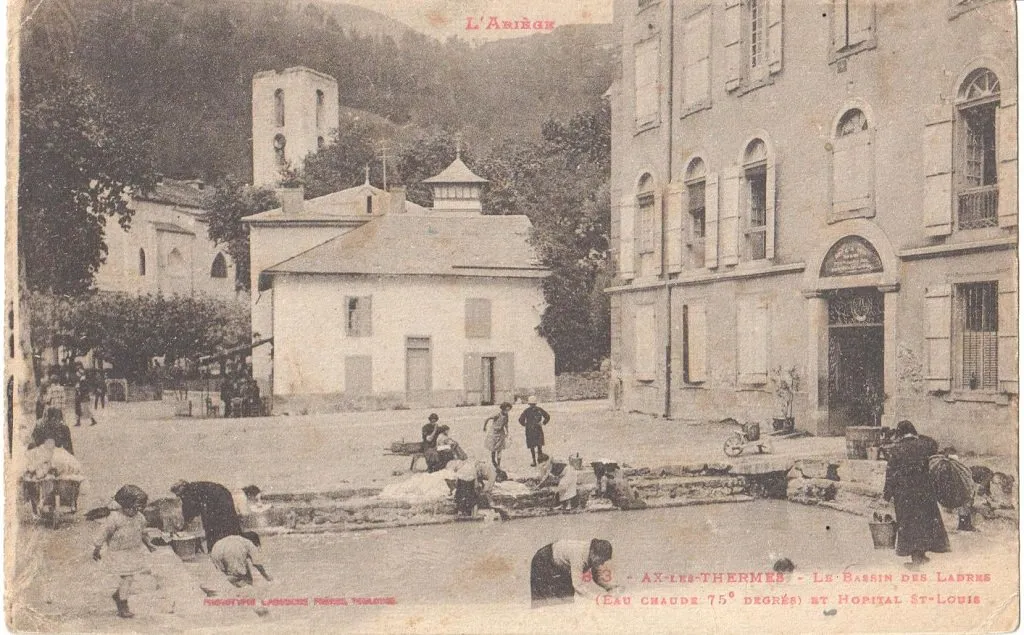
On Place du Breilh, in the heart of Ax-les-Thermes, visitors sit on the edge of a large stone basin and dip their feet into the hot water. No one asks them to pay. Some stay a few minutes, others longer. This rectangular basin, ringed by granite steps, bears an intriguing name: the Bassin des Ladres.
According to tradition, it was built in 1260, at the request of Saint Louis, to treat soldiers who had returned from the Crusades with leprosy. The word "ladre" did indeed mean a leper. It’s a fine story. It is repeated everywhere, from tourist websites to the official listing of the historic monument. But what do historians and archaeologists actually know?
This article follows the basin step by step. Where exactly is it, and in which part of town? What was known about Ax and its waters before it? What do the 2006 archaeological soundings say? And above all: is the legend of the leprous crusaders an established fact, a plausible hypothesis, or an explanation that came later?
This investigation is part of our series History of Ax-les-Thermes: six investigations into the hot water.
Milestones
| Date | Event |
|---|---|
1241 |
The Count of Foix grants Ax broad tax privileges. In the same year, Roger IV becomes Count of Foix. |
1260 |
Traditional date of the founding of Ax’s hospital. |
Second half of the 13th century |
The basin is built, at the latest, according to the 2006 soundings. |
End of the 18th century |
The name "Ladres" appears in the texts. |
1789 |
The Fontaine des Canons is covered over, according to a local guide. |
19th century |
Major restoration of the coping, the upper step of the basin. |
11 July 1979 |
The basin is listed as a historic monument. |
2006–2007 |
Archaeological soundings, followed by the HADES team’s report. |
Where is the basin?
The Bassin des Ladres stands on Place du Breilh, at the centre of Ax-les-Thermes, in front of the Saint-Louis hospital. The town spreads across the confluence of three rivers, the Ariège, the Oriège and the Lauze, at the foot of the high Pyrenean chain. It’s in this valley floor that the hot springs which made Ax’s reputation rise to the surface.
The basin is a rectangle measuring 12.50 by 10 metres, ringed by three granite steps. Its official listing notes that it is fed by hot springs that well up between the stone slabs forming its floor. It also receives the overflow from several nearby fountains, including the Fontaine des Canons, the Rossignol and the Étuve. A few steps away, the Fontaine des Canons shelters beneath a tall, vaulted stone porch, which dates from 1789 according to a local guide.
In the Middle Ages, this corner of town had a name: the "barry des bains," the bathing quarter. It’s the eastern extension of the medieval town, where most of the thermal springs were concentrated. Beside the basin stand the hospital and an adjoining chapel, Notre-Dame du Bain. The basin now belongs to the commune, and has been listed as a historic monument since 11 July 1979. Its official listing gives it, incidentally, an unexpected present-day function: public wash-house.
Ax and its waters before the basin
Before discussing the basin, one has to picture the town around it. In the mid-13th century, Ax was a walled town under the authority of the Count of Foix. In 1241, the count granted it broad tax privileges, probably to make up for damage from a fire, according to the history published by the town hall. These advantages made the town more attractive, and space within the walls grew scarce.
In this cramped town, hot water was not a luxury reserved for the sick. It was in free, everyday use: people washed wool in it, scalded pigs, made soup, and treated themselves with it. In other words, thermal water was part of daily life before it became a medicine. This point matters for what follows: Ax’s thermalism did not spring from a single decision — it grew out of ordinary uses.
The baths district had a poor reputation. According to the municipal history, beggars, street performers and prostitutes held sway there, in the streets of the steam-baths (étuves). One must therefore picture, around the basin, a lively, mixed neighbourhood, far removed from the image of a place of rest.
The legend of 1260
The most widespread version fits in one sentence. In 1260, the Count of Foix, Roger IV, founded a hospital at Ax at the request of Saint Louis, to take in soldiers who had returned from the Crusades with leprosy. The basin, adjoining the hospital, is said to have been used to treat them, and to owe its name to that role: a "ladre" is a leper.
This version is repeated by tourist sites, by the town hall, by online encyclopedias, and even by the monument’s official listing, whose text was drawn up in 1992. It is therefore firmly established. Is it plausible? The political context lends itself to it. Roger IV became count in 1241 and paid homage to Louis IX at Orléans shortly afterward. In 1243, following a conflict with the Count of Toulouse, he became a direct vassal of the crown. A count close to the king founding a hospital at his request is nothing implausible. The year 1260, for its part, falls between the two crusades led by Louis IX, that of 1248–1254 and that of 1270.
But plausible does not mean proven. Among the accounts we consulted, none cites the hospital’s founding charter, nor a 13th-century text mentioning a basin for lepers. [TO VERIFY: search for a founding charter at the Ariège departmental archives or in the papers of the Counts of Foix.] The date 1260 passes from one account to the next, sometimes with "is said to have been founded," sometimes with "was built." The official listing states outright that the hospital was built in 1260, while other sources speak of a mere tradition. This discrepancy alone shows that the question deserves to be asked.
What the excavations say
In 2006, ahead of a restoration of the basin, archaeological soundings were carried out on site by the HADES team. Their report, signed by Pierrick Stephant and Hélène Teisseire, dates from 2007 and is filed with the regional archaeology service in Toulouse. Its conclusions, as summarised in regional listings, come down to three points.
First point: the basin was built at the latest in the second half of the 13th century. Second point: its construction is very uniform, suggesting a single building campaign. Third point: only the coping, the upper step, underwent major restoration in the 19th century. In other words, what we see today is, for the most part, medieval.
What should we conclude? First, that the date 1260 is not contradicted, since that year does indeed fall within the second half of the 13th century. Second, that the soundings don’t confirm it either. They date the stone, not the intention. They tell us when the basin exists, not for whom, nor why.
One troubling fact remains. According to the same accounts, the name "Ladres" does not appear in written documentation until the end of the 18th century. Roughly five centuries therefore separate the medieval basin from the first known mention of its name. What happened in between? Three possibilities present themselves. A faithful oral memory, only set down in writing at the end of the 18th century. A local or scholarly explanation coined at that time to account for a very old basin. Or a late association between the basin and the story of the neighbouring hospital. Nothing today allows us to decide between them.
One last, simpler question: the dimensions. The official listing gives 12.50 by 10 metres. Other sources appear to give different figures.
A medieval bath
How did people bathe in this basin? Written sources are lacking, but the architecture speaks. The three granite steps running around the whole perimeter allow, according to a local guide, for a choice of depth: a simple foot bath, legs in the water, or fuller immersion. Today’s water level, kept lower than before, no longer allows for full-body bathing.
Water arrives in two ways: hot springs welling up between the slabs of the floor, and the overflow from neighbouring fountains. Ax’s waters are sulphurous, and tradition associates them with skin conditions.
Beside the basin stand the hospital and the chapel of Notre-Dame du Bain. Healing and prayer were not at odds: the hospital, the bath and the chapel formed a single place of assistance, close by the steam-baths. This gives a sense of how varied this small space was, where Christian charity, the everyday uses of hot water, entertainment and pleasure all coexisted.
From the basin to the modern baths
Until roughly the mid-18th century, Ax’s thermal centre remained concentrated around the Bassin des Ladres, with the steam-baths on one side and the Canons on the other. Things then changed: the resort saw more modern establishments open, which we’ll cover in a future article.
The end of the 18th century is also the period when the Fontaine des Canons was covered over — in 1789, according to a local guide — and when the name "Ladres" appears in the texts. Coincidence? Perhaps not: this is when the effort to organise, describe and name the thermal heritage begins. That’s a hypothesis, not a fact, and it will need to be tested in the archives. A cadastral plan from 1827, held at the Ariège departmental archives, would allow us to see the state of the district at that date.
Finally, an open question: according to a local guide, the water that feeds the basin today no longer corresponds to an independent spring rising at that spot. We’ll return to this in an article on the disappearance of Ax’s springs.
Visiting it today
The basin today serves as a foot bath: you sit on the coping and dip your feet in. It is freely accessible, on Place du Breilh. According to an online encyclopedia, every year on Saint-Jean’s Day, Ax residents cover themselves in ash and bathe there for fun.
If you’re planning a stay in the valley, see our page on the Studio Natik is a 160-metre walk from the baths.
Further reading
Sources and uncertainties
What remains uncertain. The date 1260 is a tradition, which the 2006 soundings neither contradict nor confirm. The basin’s use in treating lepers rests on tradition and on the name, whose first known mention dates from the end of the 18th century. The dimensions vary according to the source.
Sources consulted
-
Ministère de la Culture, Base Mérimée, listing PA00093770: Bassin des Ladres in front of the Saint-Louis hospital.
-
Pierrick Stephant and Hélène Teisseire, Le Bassin des Ladres (Ax-les-Thermes), archaeological excavation report, HADES, 2007, filed with the SRA Occitanie, Toulouse office.
-
Town hall of Ax-les-Thermes, page "History and thermal heritage."
-
Listing text reproduced by the Monumentum site, for the 2006 soundings and the first mention of the name.
-
Ariège departmental archives, 3 P 559, cadastral plan of 1827.
-
Roger IV of Foix: Wikipedia, CNRS Sigilla database, for the count’s chronology.
-
Local guides and tourist sites, for the Fontaine des Canons and the uses of the basin.